
Dropping print and gaining ground
Teri Saylor
Special to Publishers' Auxiliary
May 1, 2026

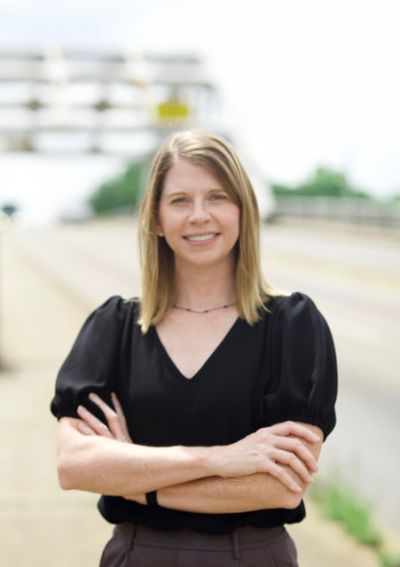
A couple of years ago, Cindy Fisher took a hit to her public notice budget that cut so deep, she decided to cease printing the Selma (Alabama) Sun, the weekly newspaper she had been publishing since purchasing it in 2018.
After securing a permit to run legal notices, the revenue stream helped fuel growth and enabled her to publish a thriving newspaper.
Located on the banks of the Alabama River, Selma has a declining population that was 17,970 at the 2020 census and by 2024 had dropped to 16,312. Advertising had begun declining, too, and Fisher found herself relying more and more on legal notices to pay the bills. Still, she found herself struggling.
“It's hard to maintain a print paper in that kind of market, especially if legal notices are all the advertising you’ve got,” Fisher said. “There are only so many people who foreclose on their houses, and there's not much you can make on legals, even if you publish voter lists.”
Then a law was passed in Alabama allowing tax collectors the option of publicizing tax lien auctions in newspapers or advertising them on tax websites. The shift cost the Selma Sun $18,000, Fisher said, and she knew it was money that would never come back.
“The tax office actually spent $1,500 with us to run ads drawing people to the online list,” she said. “The loss of those tax delinquency notices really was the nail in the coffin for our print product.”
Some publishers, when faced with a daunting hit to their budget, might consider folding, but Fisher decided to pivot and push forward, leveraging her online presence to connect with a larger readership. She launched the regional Black Belt News Network in 2023 to extend her reach, starting with five counties.
As 2025 drew to a close, Fisher ceased printing the Selma Sun. She was already growing her footprint online and in social media, and that year had logged a million online page views.
DREAMED OF BEING A JOURNALIST
As a child, Cindy Fisher dreamed of being a journalist. In an interview for an NNA profile in 2022, she described honing her skills as a young editor.
“I used to make newspapers and assign my sisters to draw pictures to go with the stories I wrote,” she said. “I still have copies of the Fisher Gazette, and we enjoy laughing about them today.”
During Fisher’s growing-up years, her dad, Bradley Fisher, was a reporter. Following in his footsteps, she used a manual typewriter to construct her newspapers when she was in elementary school and graduated to PageMaker when she hit middle school. Topics included a tornado that came through town, summaries of her favorite TV shows and a “Dear Pixie” advice column written from the perspective of her cat.
By the time she was a teenager and editing her high school paper, she had decided she wanted to publish her own newspaper someday.
She majored in journalism at the University of Alabama and worked at newspapers along the East Coast for about 20 years before forming Kingfisher Media and buying the Selma Sun. At the time, the Selma Sun was a young startup, launched in 2015 to compete with the more established Selma Times-Journal, founded in 1827 and owned by Boone Newspapers.
Selma is the Dallas County seat in the heart of Alabama’s Black Belt region. Known for its rich, dark soil, the region is a collection of 18 mostly rural counties stretching across the lower central third of the state.
The city is best known for the Selma-to-Montgomery marches, beginning with “Bloody Sunday” in 1965 and ending with 25,000 people entering Montgomery to demand voting rights. Today, about 83% of the city’s population is African American.
SEEKING GRANTS
Fisher first received $15,000 in grant funding and used it to create a special project featuring a series of healthy soul-food recipes provided by local mothers and grandmothers who had been experimenting with using healthier ingredients in their cooking. She produced videos and printed recipe cards that went into gift bags and were distributed to communities at food distribution locations. The program cemented her mission “to inform, empower and amplify the voices of Alabama’s Black Belt communities by providing free, high-quality journalism rooted in truth, equity and local impact.”
In 2024, Kingfisher Media established a partnership with Tiny News Collective to serve as a fiscal sponsor that can take tax-deductible donations. Among the early funding was a $100,000 Press Forward grant. She is pursuing establishing the Black Belt News Network as a nonprofit 501(c)(3) organization.
Because the Black Belt region has a high poverty rate — 30% in Dallas County and higher in other places — she has no paywall and considers her work a public service.
“Ours is a challenging community,” she said. “I don't want news and information to be out of reach because those who need it lack income.”
At 50, Fisher can feel their pain. She’s a single mom who sometimes struggles with buying groceries for her family, too.
“We’ve known for a while that we wouldn’t make it as a print newspaper forever, and our online News Network has always been our future plan,” she said. “We knew we were not able to be supported in a community that is low on funds — and not just the people, but the businesses, too, which can’t afford to advertise.”
Fisher runs a small newsroom. Her staff includes two reporters, a web editor and a handful of citizen correspondents. It is impossible to cover the entire region using traditional newsgathering methods. Technology helps.
Her father is a partner and associate publisher in her news operation, and he covers some of the small-town council meetings that stream on YouTube from his home in Tuscaloosa.
CITIZEN JOURNALISTS
Fisher’s team of citizen journalists attend high school football games and local government meetings, and a high school journalism class has covered school news in a student newspaper she helped produce.
She had dubbed this ad hoc network her “Black Belt Media Lab.”
“It has two arms; one is our team of adult community correspondents, and the other is my Teen Press Institute for high school kids,” she said.
The Teen Press Institute started when a friend put together a journalism class at one of the smallest high schools in Dallas County and asked Fisher to mentor the students once a week.
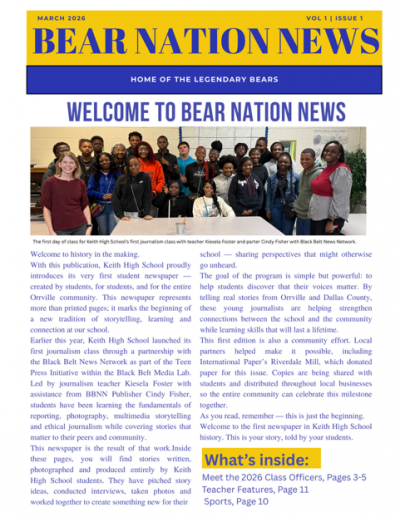
They produced the Bear Nation News, a 12-page newspaper full of photos and stories by the student staff. Fisher designed the print publication using the popular Canva graphics app. The students will produce one more issue before school is out for the summer.
“These babies have made me so happy,” Fisher said. “It’s been really rewarding — maybe more for me than for them, but the community loves it, too.”
This journalism project is in its pilot phase, and Fisher is seeking funding to keep it going.
“It has been so much fun, and I'm hoping that it generates goodwill for the community,” she said.
She dreams that some of the students will grow into future community correspondents and bolster her reporting and newsgathering.
Fisher has also stepped into the broadcast arena, producing a half-hour YouTube newscast at midday on Fridays with reporter Todd Prater.
After the broadcast, she carves the show into three-minute segments, and those go up on YouTube and the News Network’s website as shorts and on Tik Tok and Instagram as video reels.
“Now our audience can watch it three minutes at a time, and they can get the news on their phones wherever they are,” she said.
A daily newsletter featuring the top headlines is part of her news package, and some of her website advertisers place ads in the newsletter, too. The newsletter boasts a 37% open rate, and her online engagement continues to grow.
“Our Facebook reach has hit 10 million,” she said. “The News Network’s Facebook page has over 5,000 followers, and the Selma Sun Facebook page, which is still online and active, has 15,000 followers. Both sites carry the same posts.”
Looking back, Fisher acknowledges the timing was right to push her news product online.
“I published a print product that was pretty successful until the industry wasn't,” she said. “There are still many markets that are doing well in print, but mine wasn’t one of them.”
Last year, the Selma Sun celebrated its 10th anniversary even though it is now part of the Black Belt News Network, but Fisher is not nostalgic for the past. She’s looking forward to using her mission to serve her region at a high level.
“We want to be storytellers and tell our region’s story, not just for the decision makers, but for the average citizens, too,” she said. “My work helps me feel connected to my community.”
Teri Saylor is a writer based in Raleigh, North Carolina. Connect with her at terisaylor@hotmail.com.